Showing posts with label black history month. Show all posts

Thursday, February 27, 2014

Book-A-Day 27: H.O.R.S.E - A Game of Basketball and Imagination

H.O.R.S.E
A Game of Basketball and Imagination
Written and Illustrated by: Christopher Myers

You know that phrase, "anything you can do, I can do better?"  That is the essence of this story between two friends who meet up to play a game of HORSE on the basketball court but whose imaginations get the best of them.  For those of you who may be unfamiliar with the game of HORSE it's played like this (according to the character in the book), "the game where one person shoots any kind of shot -- layup, jumper from half-court, bounce shot, whatever.  The other other player has to shoot the same shot, or else that player gets a letter. Spell HORSE and you're out."  As the two friends begin to play their game they keep attempting to out perform one another with the descriptions of the shots they are going to take.  Each new description gets more and more elaborate from around the world shots to intergalactic shots.  Reading through this story and seeing the imaginations of each of the characters in relation to a simple game of basketball is such fun!  Kids will delight in hearing this story read aloud, particularly young boys.  You might even find them on the blacktop at recess later in the day attempting to out-do one another in their own imaginative game of HORSE. 

Because this story has a distinct back and forth rhythm to the reading, it would make for a great shared read aloud.  Two people could perform this story for a class of students and the giggles and smiles will quickly ensue.  

Christopher Myers both wrote and illustrated this book.  It was published in 2012 and was awarded a Coretta Scott King honor.  Check out the video interview below to learn more about this author and illustrator.

Tuesday, February 25, 2014

Book-A-Day 25: My People

My People
Written by: Langston Hughes
Photographs by: Charles R. Smith Jr.  

I adore this Coretta Scott King Award winning book! Langston Hughes is one of my favorite poets and his poems carry such power in their simplicity.  Combining the poetic words of Langston Hughes with perfectly captured photographs taken by Charles R. Smith Jr. create a powerful book to share with students. While the poem itself is only thirty-three words in length it serves as an anthem to celebrate african-americans.  Originally written by Langston Hughes to lift-up and celebrate African-Americans during the 1920's when they were not acknowledged much in society.   Charles R Smith Jr. has captured the many faces of African-Americans so well as he worked to pair photographs with words from the poem.  He says in a note at the end of the book, "I wanted to show skin color as bright as the sun and as dark as the night; I wanted to show the newness of a newborn smile and the wisdom of wrinkled skin.  But, more than anything, I simply wanted to show that like any other group of people, black people come in all shapes, sizes, shades, and ages, and that each of us is unique."

Here are the words to Langston Hughes' poem that filled the pages of this book. 

MY PEOPLE
The night is beautiful,
So the faces of my people.

The stars are beautiful,
So the eyes of my people.

Beautiful, also, is the sun.
Beautiful, also, are the souls of my people. 


This would be a perfect book to inspire kids to create their own artistic interpretation of a poem.  Students could choose a poem and then use iPads to capture images that could illustrate the poem when broken apart.  What do they see in their mind's eye when they read their chosen poem?  How can they convey that through photographic images? 

Langston Hughes was a famous African American poet whose work is still celebrated to this day.  To learn more about him and his writing click here.  Charles R. Smith Jr. is an author and illustrator for children's books and we have many of his titles in our school library.  You can learn more about him here.  


Monday, February 24, 2014

Book-A-Day 24: Dear Mr. Rosenwald

Dear Mr. Rosenwald
Written by: Carole Boston Weatherford
Illustrated by: R. Gregory Christie 

We had the distinct honor today of meeting Carole Boston Weatherford as she led our students and staff through some of her works for children (blog post about this visit coming soon).  One we did not touch on today, but would love to highlight is her book Dear Mr. Rosenwald which tells the story of the Rosenwald Schools (schools built for African-Americans in the 1920s).  Using poetic form, Mrs. Weatherford describes the process the African-American community underwent in order to provide educational opportunities for their children through the building of a new school.  While Julius Rosenwald (the founder of Sears Robuck) helped to provide partial funding for the schools, the African-American community had to raise their own share in order to move forward with the building of a new school.  The book is broken down into separate poems that carry over into a larger storyline about a young child named Ovella who has plans to attend the school when it is complete.  Through my own research learning about Northside as a Rosenwald School, I was able to make so many immediate connections to the storyline as I read page after page.  My favorite poem is the last one in the book.  It reads, 

Dear Mr. Rosenwald
Even before the bell rang,
we children lined up at the door. 
Me with bows in my hair
and ham biscuits in my lunch pail.
I share a desk with Lottie Mae.
Miss Shaw got busy right away.
Our first lesson -- letter writing. 

Dear Sir,
I am ten.  I like to read books.
My best subject is arithmetic.
My parents are counting on me
to learn all I can.  This school
is the first new thing I ever had 
to call my own.  I'm going to stitch me
a dress in the sewing classroom. 
One day, I'll be a teacher like Miss Shaw. 
Thank you, Mr. Rosenwald.
Yours truly,
Ovella

Many of the historic Rosenwald schools have since been torn down (including the original Northside) but many that remain have become historic trusts.  This would be a wonderful book to read prior to, or in the midst of examining the history of our own school as a Rosenwald school.  It would serve as a wonderful mentor text for students to engage in close reading and have them begin thinking critically about what these schools meant for the African-American community.  What did they symbolize?  It could also serve as a model text for how a storyline can be created in a poetic form.  Have students examine where Mrs. Weatherford chose to make certain breaks in her poems and discuss how those influence the reading of the poem.

Carole Boston Weatherford began writing in first grade and we learned today that it is something she has always loved to do.  She has written many books for children and has been honored with Coretta Scott King, Caldecott and NAACP book awards for her work.  She currently lives in Fayetteville, NC and teaching English Literature at Fayetteville State University.  We have many of her titles in our library collection.  Illustrator R. Gregory Christie has helped illustrate a number of books for children including Only Passing Through: The Story of Sojourner Truth. 

Sunday, February 23, 2014

Book-A-Day 23: Wind Flyers

Wind Flyers
Written by: Angela Johnson
Illustrated by: Loren Long

This book is a wonderful collaboration between children's author Angela Johnson and Illustrator Loren Long that tells the history of the Tuskegee Airmen, an all-black group of fighter pilots that was formed in 1942 and trained in Tuskegee, Alabama.   Told through the eyes on a young boy, simple yet powerful words, describe the story of his great-great-uncle and how he came to be a pilot for the United States Air Force during World War II.  Although the story is fiction it is based on historical facts and does a wonderful job of honoring the men who played an important role in our country's history through the lens of story that even young children can understand and appreciate.  The author's note at the ends provides a short history on the Tuskegee Airmen and describes how the 332nd fighter group was the only military escort group that never lost a single bomber to enemy fire.  A fascinating history that has often been overlooked but played a significant role in helping pave the way for civil rights in the 1960's. 


At the upper grades, this story could be used to spark interest around the role  of minorities in the military.  Students could brainstorm a list of questions they have about the Tuskegee Airmen and use those questions to drive their research.  Have students complete a comparison between the Tuskegee Airman and the Native American Code Talkers during World War II.  Students can dive deep into understanding the critical role both of these minority groups played in the history of our country and how they were treated upon returning from war.  What can we learn from those historical experiences? How can we inform our community about these histories to learn from them? For younger students, this would be a wonderful book to discuss the concept of "then and now".  The young boy learns his great-great-uncle's history and in doing so learns about the past.  How could our students interview their own parents or grandparents to learn from the past?  How could they use that information to create their own story that teaches others about a historical event from the past? 

Angela Johnson has written many books for children including the first one featured on the Book-A-Day blog challenge. I adore how she creates simple yet powerful stories for children that model the art of writing.  Loren Long is a celebrated illustrator who has written numerous books for children.  They should be celebrated for their work on this story!

**To learn more about the Tuskegee Airmen click here.  

Friday, February 21, 2014

Book-A-Day 21: Hip Hop Speaks to Children

Hip Hop Speaks to Children:
A Celebration of Poetry with a Beat
Edited by: Nikki Giovanni

I love poetry and sharing it with children, particularly poems that carry a distinct rhythm to their words. This book does exactly that with the poems that fill it's pages - it speaks to children.  I love that there are poems taken from the lyrics of hip hop artists such as A Tribe Called Quest, Mos Def, and Young MC combined with selection from traditional poets Eloise Greenfield, Nikki Giovanni, Langston Hughes and Maya Angelou.  Included with the book is a CD in which a handful of selections are read orally or sung from the song for which the lyrics were written.  The illustrations that accompany each poem on the inside of the book are done by various artists, and they are all fun, colorful and interesting to look at from one page to the next.  Also included is an amazing introduction by Nikki Giovanni in which she describes how rhythm, rap and hip hop have been a part of societal cultures for years in various shapes and forms.  Her history into the this artistic art form is very interesting and well worth the read.  As eager as you might be to skip over this introduction - don't!  You will learn a thing or two that will give you even a greater appreciation for the poems that follow.


This would be a fun book to "take apart" and have students each study a different poem.  Each student could perform their assigned poem and then compare their performance with the poet's performance on the CD.  They could also draw a unique illustration that represents their assigned poem.  Pair their illustration with how they choose to read their poem to create a digital anthology of poetry in a collaborative tool such as Voicethread.  These poems could also be used as part of a poetry slam in which students rehearse and perform their selected poems in a creative way.  

Check out the video clip below to hear Nikki Giovanni discuss this book and share what she liked most about working on this anthology.  While this is not a recent video, it's wonderful to see Nikki Giovanni introduce this book before it's initial release back in 2008.

Thursday, February 20, 2014

Book-A-Day 20: These Hands

These Hands
Written by: Margaret H. Mason
Illustrated by: Floyd Cooper

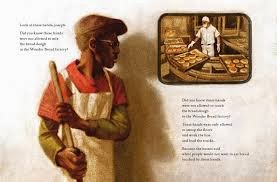
If our hands could talk, what would they say?  What memorable experiences and special moments have our hands been witness to over the course of a lifetime?  In These Hands by Margaret H. Mason, the reader gets to experience a grandfather's conversation with his young grandson about all the many things his hands have experienced with each memory beginning with the line, "Look at these hands, Joseph...Did you know these hands used to..."  He describes for his grandson how his hands used to tie triple bowline knots, throw curveballs faster than a dive-bombing honeybee, and pluck the ace of spades right out of thin air from a deck of cards.  Each mention of a memory is paired with how he can still use that skill of his hands to teach his grandson something new.  


Using the imagery of his hands, he begins sharing how "his hands were not allowed to mix the bread dough in the Wonder Bread Factory."  He describes the experience of racial prejudice and because of that how he used his hands to join with others to create change so that "now any hands can touch the bread dough, no matter their color."  The story ends with the young grandson expressing how his own hands can now do things they couldn't before such as tying his shoe, hitting a ball, or shuffling cards all because of the help of his grandfather.  My favorite line comes at the very end of the story when the grandfather says to his grandson, "Look at those hands.  Those hands can do anything.  Anything at all in this whole wide world."

This is such a tender story between grandparent and grandchild and the author captured the loving bond between them well.  She did a lovely job of bringing forth the topic of racial prejudice in a way that is understandable for young children and will spark a conversation on racial inequality that existed in our country not that long ago.  This book would serve as a wonderful mentor text to kickstart an oral history project.  Students could interview their parents or grandparents about things their "hands" have experienced in their lifetime and special talents they hold.  They could then create their own "These Hands" book with information gathered from their own family.  

Author Margaret H. Mason includes an author's note at the end of the book in which she describes how she came to write this story.  You can learn more about her here.  Celebrated illustrator Floyd Cooper has won many awards for his illustrations in various children's books.  Click here to learn more about him. 

Saturday, February 1, 2014

Celebrating Black History - Book-A-Day - Day 1

Each February we celebrate Black History Month and often try to incorporate stories of people past and present that have helped shape this rich history that is part of our own.  This year, I wanted to do more than simply recommend books.  I wanted to showcase books written by African American authors or that feature African American characters that could be incorporated into the learning experience throughout the year not just for one month.  I wanted to feature books that students could see themselves in and that feature contemporary African American characters and not just those famous African American icons we have come to know so well.   Each day, I will highlight a new title and share a suggestion for how it could be incorporated into the curriculum.  All of these titles would be wonderful choices to share during the month of February and beyond.  While I will only be shining the spotlight on 28 books, please know there are many more that could have been incorporated.  You can find all the titles that will be shared and more in our school library collection. 

Lottie Paris Lives Here by Angela Johnson

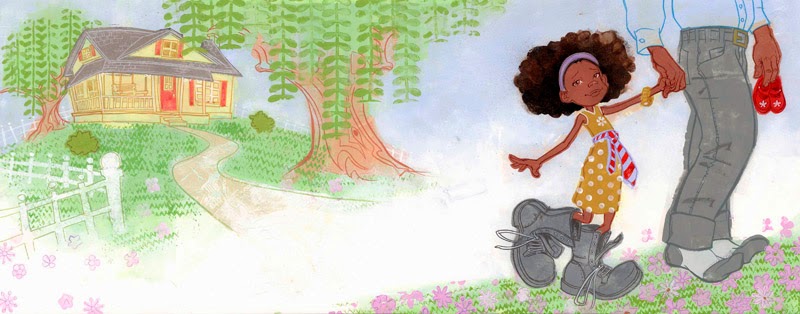
Angela Johnson is one of my favorite childrens' authors with books like The Sweet Smell of Roses and Lilly Brown's Paintings.  She is also a three time Coretta Scott King book award recipient.   My new favorite title written by her is Lottie Paris Lives Here.  With the spunk and sass of any young girl who is sure of herself, you can't help but adore Lottie. The only characters in this story are Lottie and her Papa Pete, with the real emphasis being on Lottie and the things she likes to do.  Lottie likes to play dress up, play at the park across the street from her house, and eat cookies instead of vegetables.  


Lottie may be one of my new favorite characters and definitely my new favorite girl character.  The story has a  rhythm to it that would make for a good read aloud.  One of my favorite lines from the story is next to the spread in which Lottie is decked out in her special hat complete with pearls, various kinds of flowers strewn atop along with a green frog.  "Do you like Lottie's hat?  Uh-huh, me too.  Lottie sure can wear a hat.  Not everyone can wear a hat like that."  Now that is the kind of book character I wish I could get to know in real life -- the kind who automatically makes your world more interesting just by knowing them. 


This story will be a fast favorite among many and even my two year old son now loves Lottie as he runs through the house singing "Lottie Paris....Lottie Paris....Lottie Paris!"  


This would be a wonderful book to use as part of an All About Me unit in which kids discuss where they live, what they like to do, etc.  Readers get to learn all these things about Lottie which could encourage students to share their own connections.  This book could also be used to help teach character traits in writing.  Angela Johnson does a nice job of giving the reader a strong description of Lottie without explicitly using adjectives to describe her.  Readers could practice inferring in order to create a character map.  I'd love to hear more creative ways you may decide to use Lottie Paris in your classroom or what your students think of her and if they love her as much as I do.